
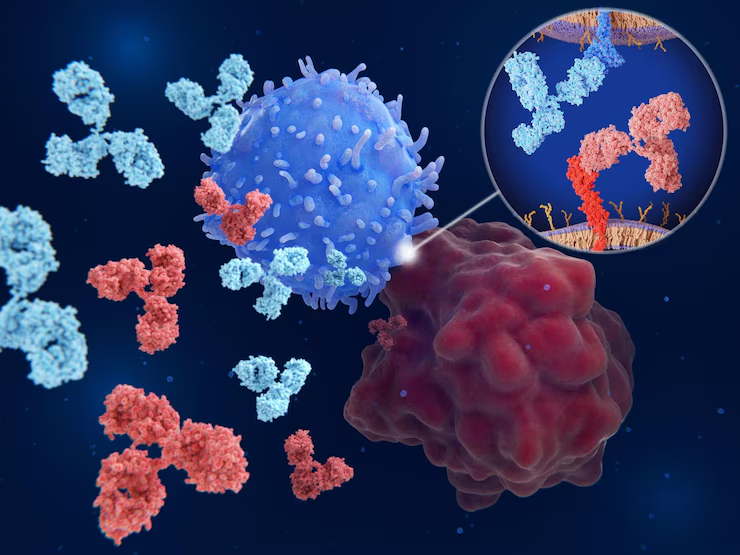
Secondary antibodies help detect specific molecules (called antigens) in a sample. They do this by attaching to primary antibodies, which are already bound to the target antigen.
Secondary antibody usually carries a “tag” or label that helps researchers see or isolate the target.
Using labeled secondary antibodies to detect targets (called indirect detection) has several benefits over directly labeling the primary antibody:
- Stronger signal – Many secondary antibodies can bind to one primary antibody, making the signal easier to see.
- More flexibility – The same secondary antibody can be used with different primary antibodies.
- Greater versatility – One primary antibody can be used in different experiments by pairing it with different secondary antibodies (e.g., one for Western blot and another for fluorescent imaging).
- Widely available – Secondary antibodies for many species are easy to find and come in various tag types.
There are two main ways to detect primary antibodies:
- Indirect detection – Using a tagged secondary antibody that binds to the primary antibody.
- Direct detection – Using a primary antibody that already has a tag.
What Things To Consider?
Picking the right secondary antibody is important for accurate and sensitive results. Here are a few things to consider:
Species match
The secondary antibody must be made to recognize the species in which the primary antibody was made.
| For example, if the primary antibody was made in a mouse, the secondary antibody should be an anti-mouse antibody, raised in a different species, like a goat.
Also, make sure the secondary antibody matches the type (class or subclass) of the primary antibody. |
Most polyclonal primary antibodies are IgG, so the secondary should recognize both heavy and light chains (H+L).
Monoclonal antibodies may be specific to a subclass (like IgG1), so you’ll need a subclass-specific secondary.
Clonality
It refers to whether the antibody is polyclonal or monoclonal:
Polyclonal secondary antibodies are a mix of antibodies that can bind to different parts of the same target. They’re more sensitive and better for detecting small amounts of a target.
Monoclonal secondary antibodies are identical copies that bind to just one specific part. They are more specific, so they’re ideal for precise detection (like distinguishing between antibody types).
Host Species – Where the Secondary Antibody Comes From
The host species is the animal in which the secondary antibody was made. It’s important that this animal is different from the one used to make the primary antibody.
- Most primary antibodies are made in rabbits or mice.
- Secondary antibodies are commonly made in goats.
This difference helps avoid unwanted binding between antibodies.
In experiments where you’re using more than one primary antibody at the same time (called multiplexing):
- Try to use primary antibodies from different species (like one from a mouse and another from a rabbit).
- Use secondary antibodies that are all made in the same species (like goat) to reduce the risk of them binding to the wrong primary antibody.
Antibody Format – Whole vs. Fragment
Secondary antibodies come in different formats depending on how they are made:
- Whole antibodies – These include the full structure of the antibody.
- Antibody fragments – These are smaller pieces, such as F(ab’)₂ or Fab’ fragments.
The format you choose depends on your experiment:
- Fragment antibodies are smaller, so they can move more easily through tissues. This makes them a better choice for experiments like:
- Immunohistochemistry (IHC)
- Immunofluorescence (IF) in tissue samples
- These fragments also help reduce background noise because they don’t have an Fc region, which can sometimes stick to cells like B cells, macrophages, and NK cells that have Fc receptors.
However, there’s a trade-off:
Fragment antibodies are less sensitive than whole antibodies because they can carry fewer detection tags (like dyes or enzymes).
Type of Conjugate – What the Antibody Is Labeled With
Conjugates are the special tags or labels attached to secondary antibodies. These tags help detect or measure the target protein. Choosing the right conjugate depends on:
- What experiment you’re doing, and
- How do you plan to detect the result?
| For example:
In a Western blot, if you’re using chemiluminescence (a method that gives off light), you should use a secondary antibody labeled with HRP (Horseradish Peroxidase). |
If you’re using fluorescence (detecting glowing signals), go for a secondary antibody tagged with a fluorescent dye.
| Application | Recommended Secondary Antibody Conjugates |
| Western Blot | • HRP-labeled (for chemiluminescent detection)
• AP-labeled (for colorimetric detection) • Fluorescent dye-labeled (for fluorescent detection) |
| Immunohistochemistry (IHC) | • HRP or HRP-polymer labeled (for chromogenic IHC)
• Biotin-labeled (for signal amplification) • Fluorescent dye-labeled (for fluorescent IHC) |
| Immunofluorescence (IF) | • Fluorescent dye-labeled
• HRP-labeled (for TSA-based amplification detection) |
| Flow Cytometry | • Fluorescent dye-labeled
• Enzyme-labeled • Biotin-labeled (used with fluorescent-labeled streptavidin) |
| ELISA | • Biotin-labeled
• Enzyme-labeled (e.g., HRP, AP) |
Cross-Adsorbed Secondary Antibodies
Cross-adsorbed secondary antibodies are regular polyclonal antibodies that have been specially purified to remove unwanted binding to antibodies from other species.
Why is this important?
Sometimes, secondary antibodies can accidentally bind to the wrong antibodies or proteins in your sample.
This can cause high background noise or false signals, especially in complex experiments like multiplexing (when using more than one primary antibody at a time).
How are they purified?
- The antibodies are passed through a column containing proteins from other species.
- Any non-specific antibodies (that would bind to those other species) get trapped in the column.
- Only the highly specific antibodies come through and are collected for use.
- This extra step helps ensure cleaner, more accurate results with less background interference.
For more information visit us : youngmagazines.com
Author




Leave a Reply